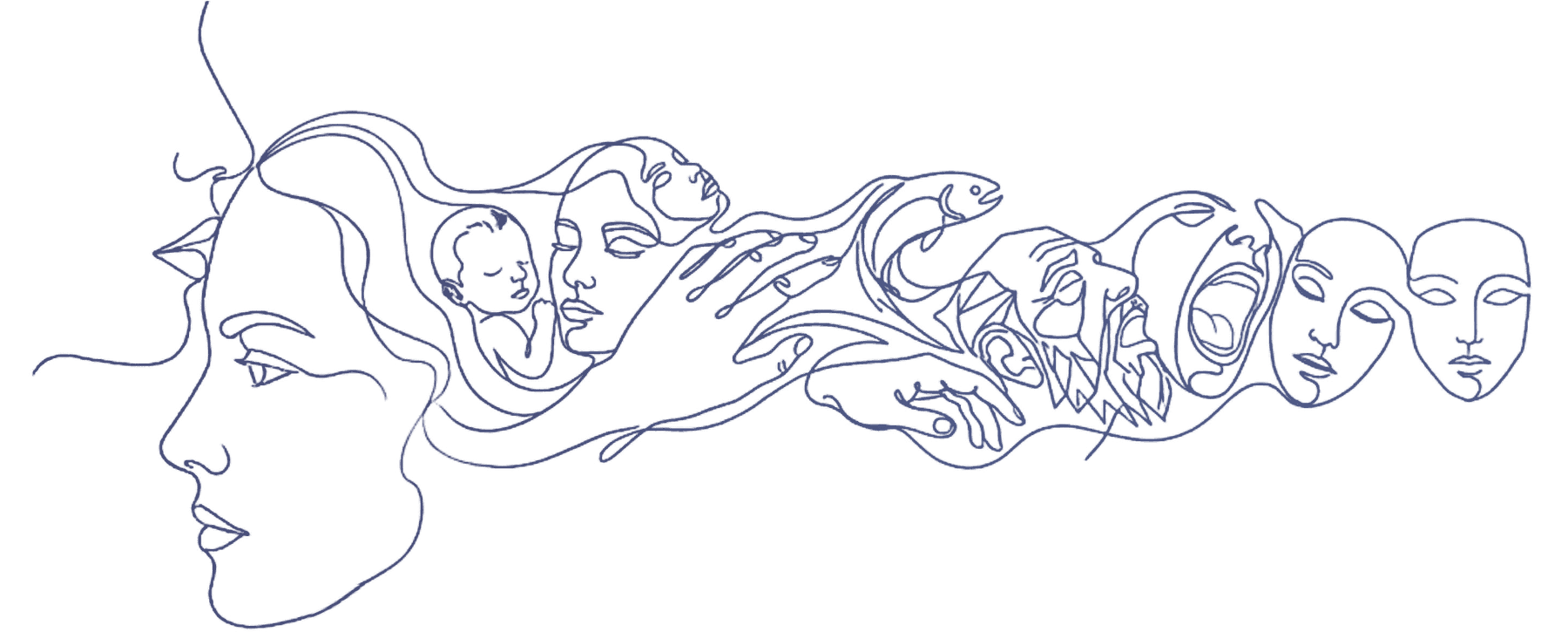
None of it is random — most of our thoughts run as a sequence. This book shows you the patterns underneath, so you can nudge the loop toward novelty.
Five minutes, five thoughts. A short diagnostic that surfaces the loops running your life right now. The audit will map their gravity, role, and the cycle they're stuck in — giving you a snapshot to decide if the book is for you.
Identify the 3–5 recurring thought loops that have dominated your headspace over the last two weeks. Start by giving them all a name and category. Don’t worry about the specific details; focus on the core themes. Feel free to close your eyes and use pen and paper at first.
Each glyph row is one of your recurring thoughts orbiting the mind. They come forward when they pull on you and fade as they pass behind — the bottom-front slot is the thought running you right now.
Contemplative traditions built a vocabulary for monks. This book turns their observations into a system for reclaiming attention, focus, and flow under load. Same insights. Different operating manual.
Your thoughts are loaded by where you sit.
Memory and emotion are uploaded by your physical environment. The "sick" feeling at one train station, the narrow-mindedness of a particular desk, the sudden lift of a borrowed jacket — these aren't moods. They're loads from local storage. This can be manipulated in office or remote desk layout.
An argument is a wave that has to crest before it ends.
Repetition in a fight is a control urge — the conversation is replaying memory, not exchanging information. The dialogue keeps running on its own fumes until the cycle completes. Even when amicably concluded, there are still lingering feelings that might arise again. Once you can see the cycle, you stop feeding it.
Every loop quietly subtracts from your focus.
Borrowed from poker game theory: every internal monologue carries an expected value, lowering or raising our energy frequency. Frequency +EV — staying equanimous through gain and loss. F-EV — getting dragged by every external swing and carrying repetitive loops that drain mental storage. The switch is trainable.
A well-arranged dish triggers appetite even when you weren't hungry — the eye-sense manufacturing a need. It happens constantly, mostly unnoticed: needs and senses are the two sources of thought we almost never catch in the act. Memory and concepts fuel the deeper, slower, fewer thoughts; needs and senses fuel the fast, shallow ones that flood in all day.
The link maps onto two dimensions:
Needs ≈ Space. A need either is, or implies, a change in location — going to the kitchen, going out, going to bed.
Senses ≈ Time. A sense either is, or implies, a moment — this sight, this sound, right now.
And they trigger each other. A change of place floods you with impressions, and impressions become thoughts. An object in your sight hooks into a memory, a desire, or — more rarely — into the present moment itself.
A separate space for full diagnostics, persistent history, and how to deal with your emotions by yourself and with your cohort.